

In an exclusive WAFI Dialogue, leading agri-policy expert Prof. KE Bingsheng maps the pressures, productivity gaps, and innovation pathways shaping the future of China’s food system—and what it means for the world.
As nations worldwide seek to build more resilient and sustainable food systems, China’s agricultural transition carries unique global significance. Having achieved the historic feat of feeding nearly 20% of the world’s population with only 9.3% of its arable land, the country now faces a pivotal new chapter: shifting the national priority from securing “enough food” to ensuring “better food” for its people.
This qualitative leap—the pursuit of a “better food”—is not merely a domestic concern. It represents a next-generation challenge for any major economy that has overcome basic scarcity. How China navigates this transition—balancing growing demand against resource constraints, and leveraging technology against structural bottlenecks—offers critical insights for global food security dialogues.
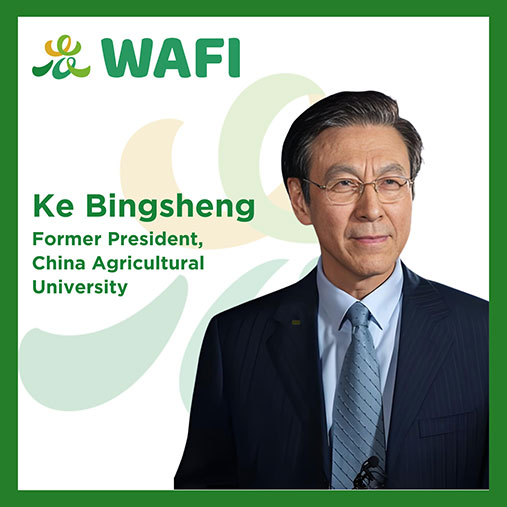
Professor KE Bingsheng, former President of China Agricultural University and a seminal voice in agricultural policy, provided a comprehensive analysis of this very transition. Moving beyond simplistic narratives of self-sufficiency, Professor KE presented a clear-eyed assessment of the pressures ahead and outlined a coherent framework for innovation-driven growth.
The New Baseline: A Foundation of Quantity, A Demand for Quality
China’s food production achievements are profound. Between 1978 and 2025, total grain output is projected to rise from 300 million tonnes to over 714 million tonnes—an increase of 1.35 times—while meat production has grown more than tenfold. Today, the country produces about one-fifth of the world’s grains and over a quarter of its meat on a fraction of the globe’s farmland. At an individual level, this translates to a per capita grain production of 502 kilograms, roughly four times the annual direct consumption per person.
This solid output forms a bedrock of national security. Staple grains like rice and wheat are now produced in volumes double domestic consumption needs, guaranteeing what Professor KE terms “absolute staple food security.” Yet, this very success has ushered in the central challenge of the next era: as incomes rise and diets diversify, public demand has decisively shifted from quantity to quality. The core question is no longer “Is there enough?” but “Is it good, healthy, and sustainable?”
Confronting Dual Challenges: The Structural Shift and the Productivity Gap
Meeting this “better food” demand is complicated by two interconnected challenges. The first is structural demand pressure. The primary driver of future agricultural demand is no longer staple grains for direct human consumption, but feed grains for livestock and aquaculture. China has become the world’s largest net importer of agricultural products, and nearly 90% of this import value is comprised of feedstuffs like soybeans, along with animal and aquatic products. This “feed gap” underscores a growing dependence on global markets for protein production.
The second, more fundamental challenge is a domestic productivity constraint. Chinese agriculture operates under the persistent realities of limited arable land per capita, small and fragmented farm plots, and an aging labor force. The consequences are measurable: key crop yields, such as corn and soybean, remain below 60% of U.S. levels. Overall production costs are high, largely due to elevated land and labor expenses compared to major exporting nations. Most strikingly, agricultural labor productivity in China is estimated to be sixty times lower than in a country like Canada. This efficiency gap explains why many Chinese agricultural products struggle to compete on cost in an open market, creating the price differential that fuels large-scale imports.
A Framework for Transformation: Four Interlinked Pathways Forward
Professor KE proposed that overcoming these hurdles requires a dual focus on technological and institutional innovation, operationalized through four key pathways.
The first pathway involves modernizing and specializing production systems. The future lies in scaling up four distinct sectors: mechanized field crop production, controlled-environment horticulture, industrialized animal husbandry, and regionalized perennial fruit farming. In practice, this means consolidating land in plains regions to enable large-scale mechanization, promoting high-tech greenhouse systems that generate immense value per unit of land, and supporting integrated livestock companies that achieve world-class efficiency, as exemplified by firms producing one-tenth of the nation’s pigs.
The second pathway is the accelerated deployment of science and technology. The goal is unambiguous: breed and engineer for higher yields, superior quality, and lower costs. Innovations like perennial rice, which drastically reduces planting effort, point the way. Crucially, technology must reach the field. This is the role of models like the “Science and Technology Backyard,” where graduate students embed in villages to solve local problems—a model now active in over 2,000 locations. Parallel organizational innovations, such as service cooperatives that manage land without owning it, help create the scale needed for technology to pay off.
The third pathway highlights the catalytic role of local governments and adaptive policy. Centralized, one-size-fits-all mandates are less effective than empowering local authorities to design strategies around regional strengths, much like Yan’an City did in building an apple industry that now employs 80% of its local workforce. Policy should foster an environment conducive to experimentation in both technology adoption and business models.
Finally, the fourth pathway advocates for the strategic use of global trade and cooperation. Importing land-intensive products like soybeans is a rational choice that conserves vital domestic resources; the current import volume effectively saves an area of Chinese farmland equivalent to the combined total of the Northeast and North China plains. Furthermore, as demonstrated during recent trade tensions, a calibrated trade policy can turn agricultural imports into a tool of diplomatic and economic leverage, strengthening the nation’s overall position.
Conclusion: Building a Resilient, Quality-Driven Food Future
The journey from “enough” to “good” is the defining mission for the next phase of China’s agricultural development. It is a complex undertaking that sits at the intersection of consumer aspiration, geopolitical strategy, and ecological reality.
Professor KE’s analysis makes clear that success hinges on systemic thinking. It requires that technological breakthroughs, scalable business models, pragmatic local governance, and smart international engagement advance in concert. When these elements align—when policy enables organization, organization adopts technology, and technology unlocks quality and efficiency—the system can transcend its current constraints.
This transition promises more than just better meals. It is integral to rural revitalization, environmental sustainability, and long-term national resilience. For the global community, engaged in its own parallel struggles, China’s efforts to reinvent its food system represent a vast landscape of lessons, challenges, and potential partnerships.
About Us
The WAFI Dialogue is a leading thought leadership series presented by the World AgriFood Innovation (WAFI) Conference. It serves as a global platform for pioneering thinkers—scientists, educators, entrepreneurs, and innovators—to share insights that shape the future of agriculture and food under the vision of “Innovating AgriFood, Sharing Future.”
World AgriFood Innovation (WAFI) Conference is a global platform dedicated to advancing integrated innovation across agrifood systems. Anchored by its annual international conference and supported by year-round engagement mechanisms, WAFI accelerates agrifood systems transformation by fostering dialogue and collaboration among governments, industry, academia, research institutions, and practitioners. Together, these stakeholders address pressing global challenges, including food security, climate change, and sustainable development. WAFI is committed to shaping a healthy, resilient, inclusive, and sustainable agrifood future, providing global innovators with a practical, long-term, and open platform for collaboration.


警告:当心骗子
世界农业科技创新大会致力于保护客户的隐私。近期,我们接到报告,有不法分子冒充大会工作人员,试图通过出售假冒的与会者名单或其他敏感信息来骗取钱财。我们在此郑重声明,世界农业科技创新大会绝不会出售任何与会者或合作伙伴的信息。我们严格遵守国家相关法律法规,对您的个人信息给予最高级别的保护。
若您收到任何声称来自大会的电子邮件或电话,要求您支付费用以获取数据或提供个人信息,请务必提高警惕,切勿轻信;并及时与大会组委会核实信息[work@wafiforum.com]。
了解更多