

As the world grapples with climate change, population growth and food security challenges, artificial intelligence (AI) is emerging as a transformative force in agriculture—one that could redefine how we produce, distribute and consume food worldwide.
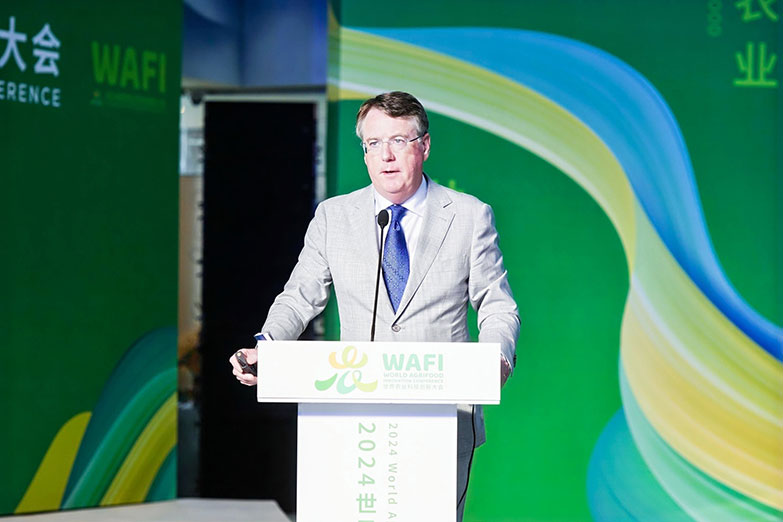
Figure 1: Aidan Connolly at WAFI2024 Agrifood Industry Innovation and Investment Forum
Ahead of the 2025 World AgriFood Innovation Conference (WAFI), we sat down with Aidan Connolly, President of IFAMA (International Food and Agribusiness Management Association) and President of Agritech Capital, to explore how AI is reshaping global agriculture and enabling a more resilient food future.
A Vision Forged Through Global Experience
With 30 years spanning 100+ countries, Aidan Connolly brings a unique cross-sector perspective to the AI-agriculture convergence. As an investor, advisor, policy influencer through the global IFAMA organization and academic (holding positions at University College Dublin, China Agricultural University and Purdue University), he has consistently championed technological innovation where it matters most: on the ground.
From pioneering nutritional technologies at Alltech as Chief Innovation officer, to computer vision for livestock monitoring at Cargill backed start-up Cainthus where he was CEO and now implementing AI solutions in livestock and farm management, Aidan’s work demonstrates how technology can tackle core challenges in efficiency, sustainability and resilience.
AI As Agriculture’s “Central Nervous System”
In Aidan’s view, we are entering an era of “collaborative technologies” where AI acts as the critical integrator. “AI is the glue that pulls together the information we’re receiving from different technologies,” he notes. Its impact is most evident in three areas:
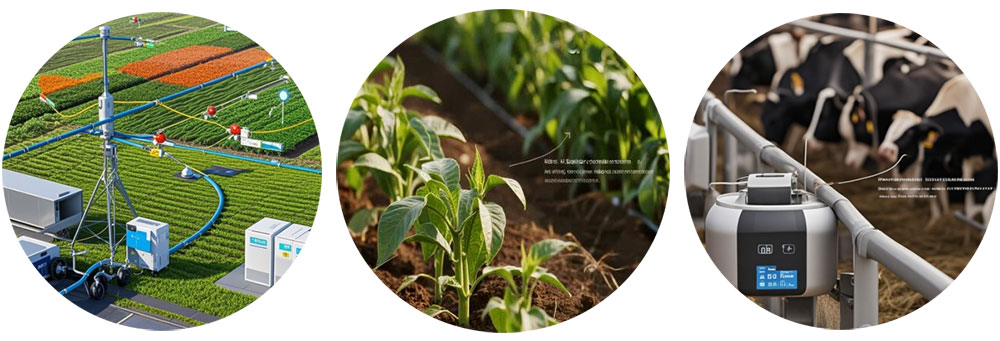
Precision Livestock Farming: IoT wearables (“Fitbits for animals”) enable real-time health monitoring, with AI algorithms predicting disease and automating feeding/milking via robots—boosting welfare and reducing labor costs.
Sustainable Production: AI processes soil sensor data to enable precision fertilization, minimizing waste and pollution. Combined with gene editing tools like CRISPR, it accelerates development of climate-resilient crops.
Risk Resilience: By integrating historical and real-time data, AI models can simulate climate, disease and supply chain disruptions—enabling a more “predictable and responsive” global food system.
WAFI: Where Global Innovation Meets Local Impact
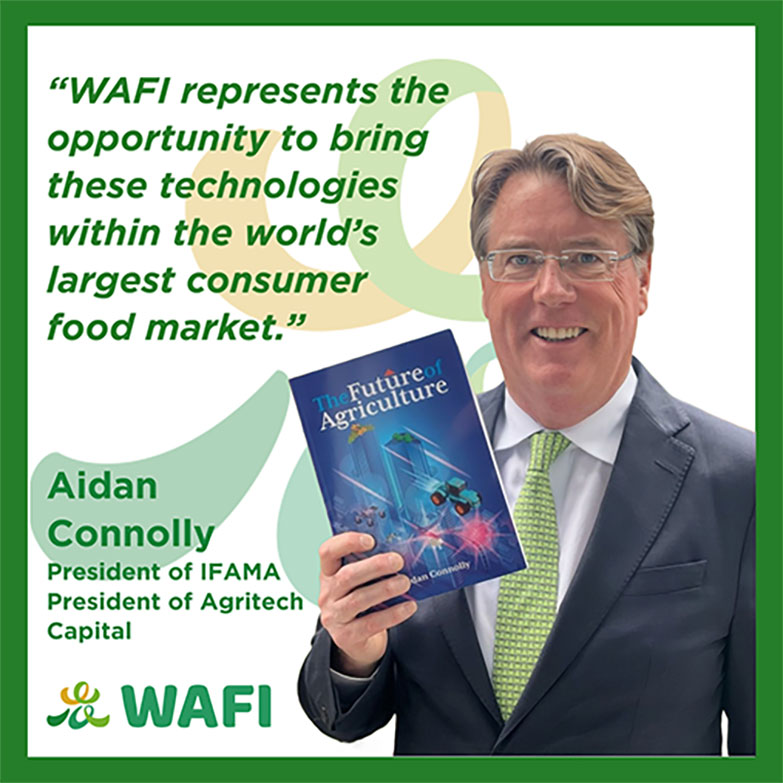
Aidan points to WAFI as a critical platform for scaling these solutions. “WAFI represents the opportunity to bring these technologies within the world’s largest consumer food market,” he emphasizes. Its role is to bridge innovation and implementation—connecting startups, scale-ups and agribusinesses with the insights and partnerships needed to drive change.
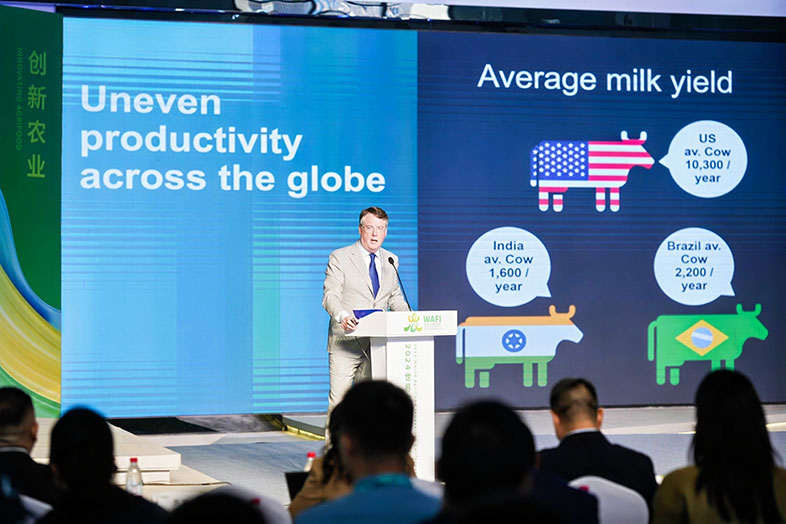
Figure 2: Aidan Connolly at WAFI2024 Agrifood Industry Innovation and Investment Forum
At WAFI2024, Aidan showcased breakthrough applications—from AI-powered avian flu detection through cameras to 3D-printed equipment repair in the U.S.—that demonstrated AI’s potential to reduce costs, boost efficiency and manage risk.
The Path to Resilience: AI and the Human Expert
Two priorities, Aidan argues, must guide the AI-agriculture evolution: ensuring food remains “affordable, available and safe,” and enhancing systemic resilience and sustainability.
He is particularly excited about the role of large language models (LLMs) in democratizing expertise. In a recent experiment, he convened a “virtual expert panel” of AI agents to debate agricultural challenges—with striking results. “The virtual discussion from an agentic AI panels perspective delivered insights every bit as good and, to some degree, better than we got with human experts,” he observes. Such tools can help break down geographic and knowledge barriers, delivering real-time insights to farmers worldwide.
Yet technology alone is not sufficient. Aidan cautions against over-reliance on data without human judgment: “Even as we add new technologies…humans need to take that information and interpret it. Mistakes occur perhaps due to the overwhelming nature of the information but also gaps in the available databases.”
He also warns against prioritizing yield over sustainability: “If we only focus on production and ignore sustainability, we may end up undermining the resilience of the entire system.”
Why WAFI2025 Matters
For Aidan, WAFI2025 represents a pivotal moment to accelerate progress. “It’s the perfect time to be in Beijing having this discussion—not just for China, but for the global requirement for food production to be done in the right way,” he says.
He sees the conference as a unique forum for aligning AI innovation with practical farm-level needs—especially for smallholders and vulnerable groups often left behind by technological change.
Join the Conversation
We thank Aidan Connolly for sharing his visionary perspectives on AI and resilience—and for supporting WAFI’s mission to foster action-oriented dialogue across the global agri-food ecosystem.
Be part of the discussion:
Share this article to spread insights from one of agtech’s foremost thinkers
Join us at WAFI2025 (October 12–15, Beijing) to help shape the future of food
Learn more at en.wafiforum.com
Aidan’s book ‘The Future of Agriculture’ at www.agritechcapital.com/books download available for free in English, Mandarin Chinese, Portuguese & Spanish.
Together, we can turn technological potential into tangible impact—for every farmer, every consumer, and every future generation.


警告:当心骗子
世界农业科技创新大会致力于保护客户的隐私。近期,我们接到报告,有不法分子冒充大会工作人员,试图通过出售假冒的与会者名单或其他敏感信息来骗取钱财。我们在此郑重声明,世界农业科技创新大会绝不会出售任何与会者或合作伙伴的信息。我们严格遵守国家相关法律法规,对您的个人信息给予最高级别的保护。
若您收到任何声称来自大会的电子邮件或电话,要求您支付费用以获取数据或提供个人信息,请务必提高警惕,切勿轻信;并及时与大会组委会核实信息[work@wafiforum.com]。
了解更多