

On the afternoon of September 1, the second session of the WAFI Summit Dialogue 2024 took place at the International Conference Centre of China Agricultural University.
The event brought together prominent leaders in agricultural technology, including Jia Li, CEO of Tongyi Carbon Neutral Technology; Changqing Mao, Co-Director of the Innovation and Entrepreneurship Research Centre at China Agricultural University; Xuebin Fan, Director of the Beijing Jingwa Agricultural Science and Technology Innovation Centre; Weidong Zhou, Director of the China Representative Office of the World Business Council for Sustainable Development (WBCSD); Ruiqiang Ma, Managing Director of Beijing Green Nitrogen Bio-technology Company; Wei Zhang, Managing Director of Sutuo Technology Company; and Junchen Liu, Chairman of Mengqing Agricultural Technology Company.
The participants engaged in an in-depth discussion on “Enterprises Addressing Climate Change and Achieving Low-Carbon Transformation.” The session was moderated by Wenge Fu, Secretary-General of the WAFI Advisory Committee and professor at China Agricultural University.
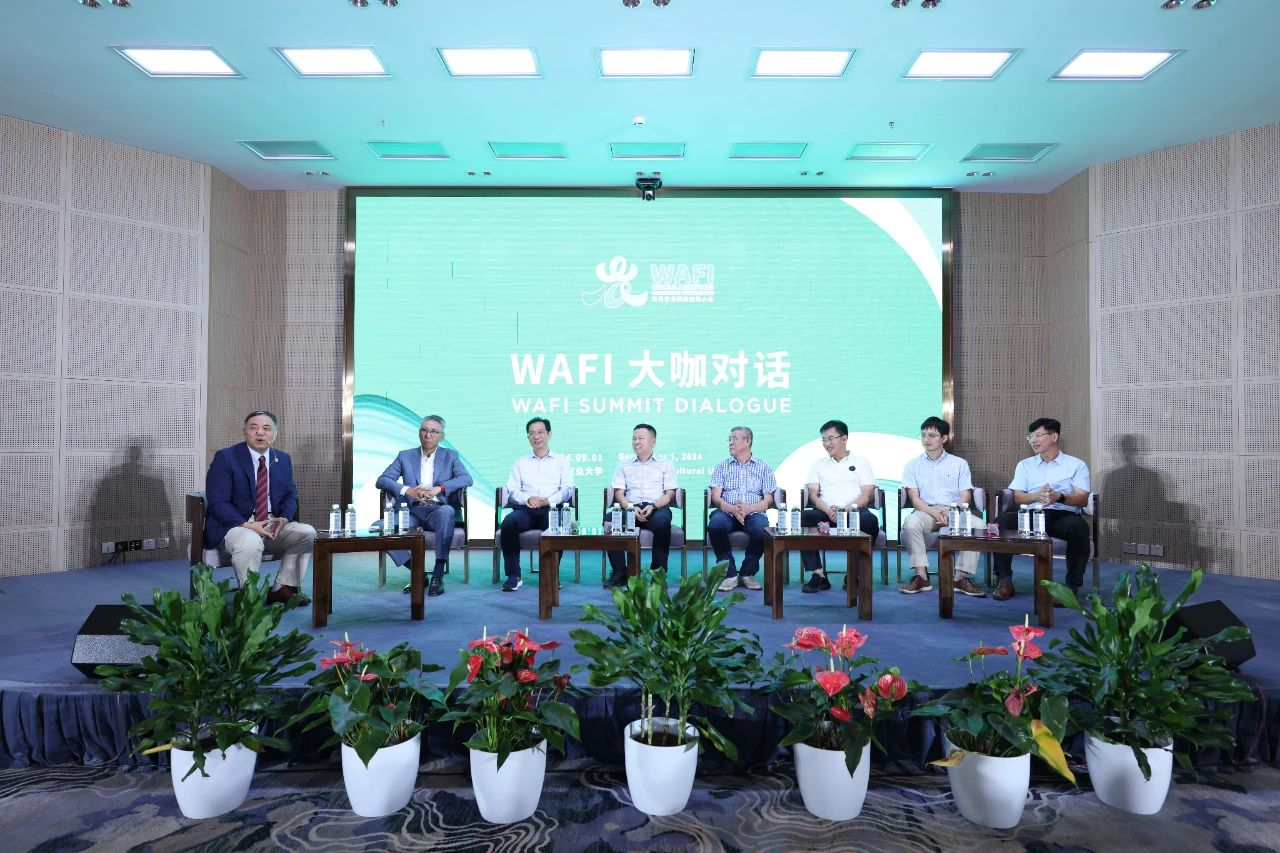
Figures: WAFI Summit Dialogue Second Session
Weidong Zhou, Director of the China Representative Office of the WBCSD, explained the significant impact of climate change on agriculture and the need and urgency for low-carbon transformation of businesses from a global perspective. He said that responding to climate change is not only a responsibility but also a new opportunity for enterprise development. Zhou called on companies to actively participate in global climate governance and shared successful examples of multinational companies in low-carbon transformation. He pointed out the importance of benchmarking with international advanced standards for companies to achieve the zero-carbon target.
Changqing Mao, Co-Director of the Innovation and Entrepreneurship Research Centre of China Agricultural University, pointed out that climate change is a trend factor that will profoundly affect the development model of agriculture. He suggested three aspects to start with to drive low-carbon transformation: Technology, market and profit model. In particular, the wide application of biotechnology and digital technology will improve the efficiency of agricultural production and reduce energy consumption and emissions. He also emphasized that each individual should implement low-carbon concepts in their daily lives and work together to promote social developments.
Xuebin Fan, Director of Beijing Jingwa Agricultural Science and Technology Innovation Centre, reported on his practical experience with the project to reduce carbon emissions from dairy cows. He emphasized that carbon emission is no longer a concept, but a real scientific research and business activity. He called that in the process of research and development, production, innovation and investment in the agricultural industry, carbon emission reduction should be a precondition or an opportunity to promote the green and sustainable development of agriculture. In conclusion, he pointed out that agriculture in Zhongguancun, the world’s agricultural highland, should play a leading role in the transition to a low-carbon economy.
Jia Li, CEO of Tongyi Carbon Neutral Technology, mentioned that enterprises should actively provide low-carbon solutions to jointly achieve the global goal of carbon neutrality. The next 30 years will be a turning point in the era of carbon neutrality; enterprises will either become poor or rich during the transition. A low- carbon transition is not only a social responsibility, but also a great business opportunity. He presented data from EY’s Consumer Trends Report 2024 and emphasised that more and more consumers are focusing on the low-carbon features of products. This will create a large market for low-carbon products.
Ruiqiang Ma, Managing Director of Beijing Green Nitrogen Bio-technology Company, introduced their innovations in the field of alternative proteins. He pointed out that this not only helps to solve the problem of food security, but also significantly reduces carbon emissions from animal husbandry and promotes the green transformation of agriculture. The young generation should be brave enough to take the responsibility of environmental protection, and actively engage in the R&D and promotion of low carbon technologies. They should contribute to the global goal of carbon neutrality.
Wei Zhang, Managing Director of Sutuo Technology Company, explored the low-carbon transformation of the agricultural and food sectors through the lens of plant-based proteins. He highlighted Sutuo Tech's innovations in this field, emphasizing the critical role of technological advancements in driving the green development of agriculture. According to Zhang, technological innovation is the key to achieving low-carbon transitions. He urged enterprises to increase investment in research and development (R&D) to accelerate the innovation and adoption of low-carbon technologies.
Junchen Liu, Chairman of Mengqing Agricultural Technology Company, shared his experience in advancing the coarse grain industry in his hometown. He explained how technological innovation and deep processing not only boosted local farmers' incomes but also turned agricultural waste into valuable resources. This transformation supports both rural revitalization and the development of low-carbon agriculture. Drawing from Mengqing Agriculture's practical experience in low-carbon transformation, Liu emphasized that companies must tailor their strategies to their specific circumstances, create feasible plans, and implement them effectively.
This session brought together insights from industry leaders to explore innovative strategies for low-carbon transformation. It provided valuable guidance for agricultural enterprises navigating this shift in the context of climate change. Looking ahead, more enterprises are expected to join the journey toward low-carbon transformation, contributing to the sustainable development of global agriculture. The live session of the 2024 WAFI Summit Dialogue was streamed to a combined audience of nearly 50,000 participants, both online and offline, who reported being deeply inspired and greatly benefited by the discussions.


Warning: Beware of Scammers
The World AgriFood Innovation Conference is committed to protecting the privacy of our Clients. Recently, we have received reports of individuals posing as conference staff and attempting to obtain money by selling fake lists of attendees or other sensitive information. We hereby declare for the record that the World AgriFood Innovation Conference will never sell information about any attendees or partners. We strictly abide by relevant national laws and regulations, and give your personal information the highest level of protection.
If you receive any email or phone call claiming to be from the Conference asking you to pay for data or provide personal information, please be vigilant and do not believe it; And check with the Organizing committee in time [work@wafiforum.com]
Know More